Dreaming Without a Tailbone
Director: Maithili Bavkar
Duration: 00:06:06; Aspect Ratio: 1.333:1; Hue: 229.489; Saturation: 0.041; Lightness: 0.745; Volume: 0.042; Cuts per Minute: 1.145
Summary: Dreaming without a Tailbone brings us to a moment in the future where it seems we have quietly lost something–a skill, an instinct. Aphantamophia, the inability to form visual imagery directly—whether voluntary or involuntary—has become widespread. Over generations, this condition has become a new norm, evolving alongside the human species. A girl from this future, finds ways to navigate this world and work around this condition.
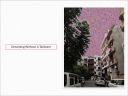
The sky serves as a mediator for visualisation and dreaming. In an apocalyptic future, a girl with Aphantamophia experiences the sky through a technological apparatus or media. For her to dream of anything beyond, she must first dream of the sky. I wonder if this technological apparatus that enables her to dream of the sky becomes the new sky rather than merely serving as a mediator.
I was reminded of Lynn Hershman Leeson's Lorna. A girl undergoing agoraphobia is trapped in her room, mediated only by a Television. The viewer/participant is left with three narrative choices: Lorna remains inside the room forever, Lorna shoots herself, or Lorna destroys the media/ shoots the television.
https://zkm.de/en/artwork/lorna
aphantasia
Download full resolution video
here.
powerpoint for the self

Photos of my neighbourhood from the year 2024
JSR flags are fractalising everywhere.
“For you know only a heap of broken images”
― T.S. Eliot, The Waste Land
“And I will show you something different from either
Your shadow at morning striding behind you
Or your shadow at evening rising to meet you
I will show you fear in a handful of dust”
― T.S. Eliot, The Waste Land
Thinking of the various imaginations of why our sky is blue in various mythologies. In Nordic Mythology, it was believed that the sky was blue because they lived in the eye of the giant Ymir (whose body made the world when odin killed it).
But on earth always already mean under the sky. -Martin Heidegger
Culture and society mediate our reality because our experiences are only possible through social contexts. The sky can represent many things: it may symbolize 'limit,' 'freedom,' 'burden,' or even a 'dream.' It is never merely a state of nothingness, as appears objectively. Instead, its interpretation is always culturally conditioned. Interestingly, Bernard Stiegler emphasizes the role of 'techne,' in contrast to the 'episteme' as a mediator of reality. This perspective is particularly relevant when considering Maithili's view on how technological mediation affects our understanding of the sky and whether it diminishes or constructs our reality. According to Stiegler, humans exist in a prosthetic relationship with reality, meaning we can only experience reality—such as the sky— by adding a prosthetic or a tool to our senses or, in other words, through technological intervention (I mean technology in a more fundamental way).
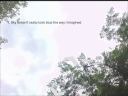
Lifting the head up in the sky while taking a walk and laying on the back while the body is at complete rest are different experiences that one encounters while 'dreaming without the tailbone'. How has evolution seen dreaming then? specially with the evolution connotation of the presence and the absence of the tailbone?
zamīn kī kokh hī zaḳhmī nahīñ andheroñ se
hai āsmāñ ke bhī siine pe āftāb kā zaḳhm
Ibn-e-Safi
Interestingly, Nordic culture also seems to be the only culture scared to cross the 'sky'; in a fear that if the giant's eye was punctured, it would drain the atmosphere of air. Also the relationship with the desire to ascend to 'heaven' is super interesting, since Valhalla is a placeholder for warrriors for ragnarok, rather than a stable, peaceful afterlife. The stakes of death thus, are very different, and the desire to ascend, die, keep dying until the ultimate battle, then die permanently; rather than being geared towards 'freedom'.
The relationship to the sky as the limit of imagination, changed permanently once we ventured to the moon. The first foot on the moon, was on the corpse of cosmological imaginations and parellel worlds held within the various cultural imaginations of what lies 'beyond'.

“A heap of broken images, where the sun beats,
And the dead tree gives no shelter, the cricket no relief,
And the dry stone no sound of water. Only
There is shadow under this red rock,
(Come in under the shadow of this red rock),
And I will show you something different from either...
― T.S. Eliot, The Waste Laond
Reminds me of the saying "आसमान सर पर गिर पड़ा". A collapse; of capacities.
“My external sensations are no less private to myself than are my thoughts or my feelings. In either case my experience falls within my own circle, a circle closed on the outside; and, with all its elements alike, every sphere is opaque to the others which surround it. . . . In brief, regarded as an existence which appears in a soul, the whole world for each is peculiar and private to that soul.”
― T.S. Eliot, The Waste Land
In the discussion, Maithli talked about memory becoming exteriorised in technological objects and how that leads to a loss of skill and knowledge. The condition of aphantamophia (unable to create visual imagery, inability to dream) as a dystopic future is very interesting to think about. If we think of technology as sensory extension, I wonder if the technological progress can become excessive after a point. Maybe the loss of perceptual ability is too profound of a loss.
Re: @Priyank 's point about human beings always living with technology and there being no past without technology, I was wondering if we can make a distinction between mediation and perception. That is, we have always lived in a technologically mediated reality, there is no outside from that mediation but on the other hand, is there any sort of direct experience that exists on a perceptual level that can nonetheless be mediated? Thinking of how looking at a sky full of stars can still be a mediated experience in terms of culture, myths, notions, etc. yet it is also experienced on a perceptual level too that cannot completely be reduced to being absolutely mediational. There is always some mystery, some feelings, emotions, etc. that we ourselves do not completely understand. Like the expression, "it's an experience".
@Mayank, yes to experience. There are chains of mediation that are connected to experience ofcourse, and what can experience what, and we can note the chain in Art> Experience> Democracy> Dewey > Education > Ambedkar, among a number of others. See also.. immediation in Erin Manning et al:)
@ Priyank, yes lovely reference. One could also think of other gentler 4th and 5th options in the history of art, like TV as
fireplace, or just connect to
neighbours haha.
'The sky is a commons to which all of humanity is entitled to have access, and that the ability to experience it is a basic human right that no corporation can nullify. However, if this is in any sense a right or privilege, it is already being violated for over half of the world's population in cities that are enveloped continuously in a penumbra of smog, vertical living and high-intensity illumination at night.' (Paraphrased from 24/7: Late Capitalism and the Ends of Sleep, Jonathan Crary)
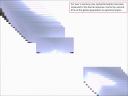
Within this construction, the sky, which is the techne of imagination further needs a technae to be accessed.
About 'the sky gone missing and trying to recreate it' part of the video, I was thinking of this video I had seen in which there's a thought experiment about a scientist 'Mary' who has never seen color but has studied everything there is to know about colors and this question of whether when she sees color for the first time, does she gain any new knowledge? I think for me, it becomes more a question of experience and understanding than knowledge. Here is the video link:
https://www.youtube.com/watch?v=mGYmiQkah4o
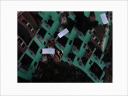
“That corpse you planted last year in your garden, “Has it begun to sprout? Will it bloom this year?”
― T.S. Eliot, The Waste Land
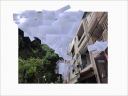
The segmentation, pixelation, breakage, construction, reconstruction of the sky on a grid like structure is needed to meander, progress, access it in all its plenitude where the capacity is rendered invisible. Constructing something that has been erased from lived memory. The grid is control. The box is a frame. The sky and the grid come face to face.
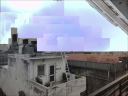
"My pal [...] has found a solution: if the images of the present don't change, then change the images of the past".
Chris Marker in
Sans Soleil, Sunless.
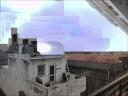
vo so rahā hai ḳhudā duur āsmānoñ meñ
farishte loriyāñ gaate haiñ us ke kānoñ meñ
Abdur Rahim Nashtar
The loss of a fundamental bodily instinct can be seen as a movement, not unlike loss that occurs when we exteriorise memory into technological objects, raising the question, ‘Is it a tragic loss?’ In many religions and mythologies, before we understood the science of the sky—before we crossed it—the sky was imagined as fantastical or magical. Even after crossing it, as Rahul suggests, there remains a reluctance, an instinctual feeling that the sky must not be crossed. Mayank’s mention of the Mary’s Room thought experiment underscores the idea that something essential is lost in merely knowing about the sky but never seeing it.
At the end of the video however, when the sky is created it does not make an attempt to replicate the real sky, rather it is a move further back in time. The sky that is created is not realistic but a fantastical, dream-like sky.
Pad.ma requires JavaScript.
